V
Ediophone +
3 ± 1

O princípio de ressonância entre voz e forma, materializou-se de maneira notável no século XIX com a soprano e investigadora gaulesa Margaret Watts Hughes (1842-1907). Em 1885, Hughes inventou o *eidophone*, um dispositivo simples composto por um tubo e uma membrana elástica sobre a qual se depositava pó ou líquido. Ao projetar a voz no instrumento, as vibrações da voz criavam na superfície da membrana padrões geométricos complexos, que ela denominou "Voice-Figures".
Recuperado e expandido no início do século XXI pelo artista Nick Laessing. Em 2007, criou a instalação performativa *Voice Figures*, na qual reconstruiu o eidophone de Hughes utilizando materiais contemporâneos como aço inoxidável, látex e tubos de metal.
Cimática, um termo cunhado pelo médico suíço Hans Jenny (1904-1972), para descrever o estudo dos efeitos acústicos dos fenômenos das ondas sonoras.
Atualmente, a cimática evoluiu para práticas que vão desde a visualização digital em aplicações como o “CymaScope” até experimentações artísticas que fundem a beleza analógica das formas de onda com a tecnologia digital. O princípio mantém-se: as frequências acústicas, ao interagirem com a matéria, revelam uma precisão matemática e uma beleza geométrica que desafiam a distinção entre ciência e arte.
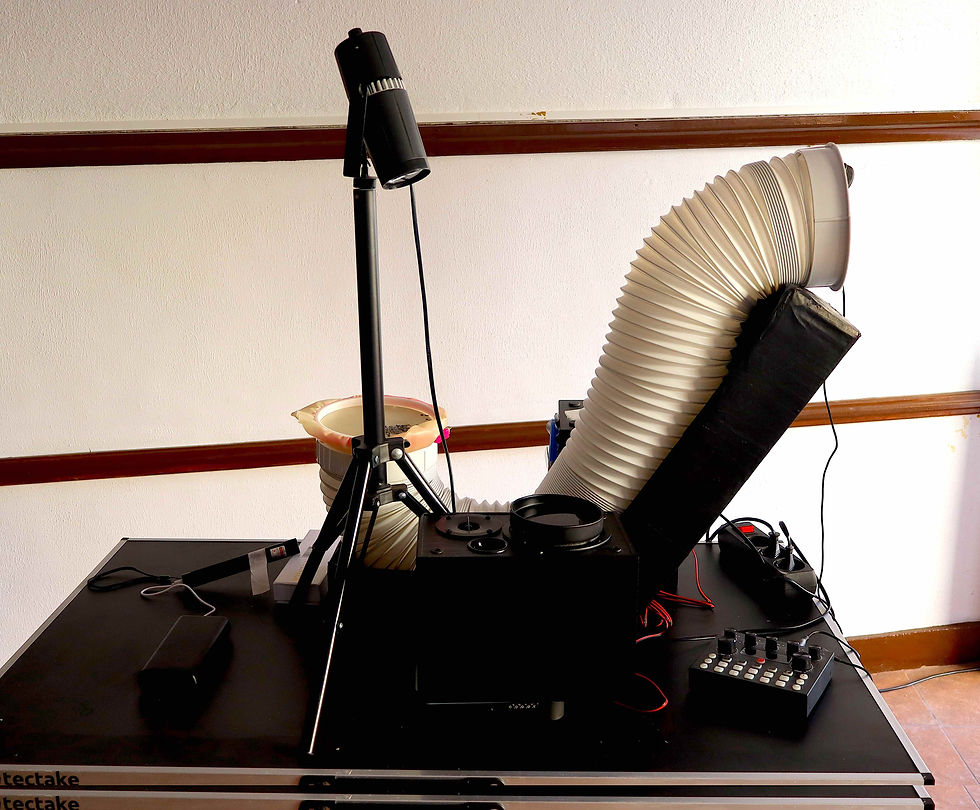
O Ediophone Plus, permite, não apenas a recriação do original, como rodeá-lo, com as tecnologias contemporâneas do cymatic e o do laser.
The principle of resonance between voice and form was notably realized in the 19th century by the Welsh soprano and researcher Margaret Watts Hughes (1842–1907). In 1885, Hughes invented the *eidophone*, a simple device consisting of a tube and an elastic membrane upon which powder or liquid was placed. When she projected her voice into the instrument, the vocal vibrations created complex geometric patterns on the membrane's surface—patterns she termed "Voice-Figures."
This concept was revived and expanded upon in the early 21st century by artist Nick Laessing. Between 2007 and 2008, he created the performance installation *Voice Figures*, in which he reconstructed Hughes's eidophone using contemporary materials such as stainless steel, latex, and metal tubing.
Cymatics is a term coined by Swiss physician Hans Jenny (1904–1972) to describe the study of the acoustic effects of sound wave phenomena.
Today, cymatics has evolved into practices ranging from digital visualization—seen in applications like the "CymaScope"—to artistic experiments that fuse the analog beauty of waveforms with digital technology. The underlying principle remains: as acoustic frequencies interact with matter, they reveal a mathematical precision and geometric beauty that challenge the distinction between science and art.
The Eidophone Plus allows not only for the recreation of the original device but also for its enhancement through contemporary cymatic and laser technologies.